

BaiYun teahouse
Fine Semi-Handmade Yixing Zhu Ni Pear-Shaped Teapot 90ml
Fine Semi-Handmade Yixing Zhu Ni Pear-Shaped Teapot 90ml
Couldn't load pickup availability
Fine Semi-Handmade Yixing Zhu Ni Pear-Shaped Teapot
90ml · Natural-Mined Zhu Ni Clay · Traditional Pear-Shaped Design
A graceful little teapot with a history spanning centuries. This pear-shaped design is known for its elegant proportions, smooth flowing lines, and slender spout. Compact yet practical, it brings together traditional craftsmanship and everyday Gongfu tea brewing.
The Story of the Pear-Shaped Teapot
The pear-shaped teapot takes its inspiration from the natural form of a pear. Its design has roots in earlier Chinese vessel-making traditions and became especially associated with Yixing teapots during the Ming Dynasty.
The celebrated potter Hui Mengchen helped make this small teapot style widely known. Active around the seventeenth century, he became particularly associated with miniature pear-shaped teapots. Today, the name “Mengchen” remains closely linked to this classic form.
There is also a story of its influence reaching Europe. European silversmiths adopted pear-shaped forms for their silver teapots, and the style became popular in England during the late seventeenth and early eighteenth centuries. Some accounts even connect this influence with Queen Anne silver teaware.
Natural-Mined Yixing Zhu Ni Clay
Made in cooperation with a pottery enterprise established in 1913, this teapot uses natural-mined Yixing Zhu Ni clay.
The clay is prepared in the maker's own clay-processing facility, following a traditional preparation process:
-
Careful Selection: The raw clay is mined, naturally weathered, and carefully sorted.
-
Grinding and Sieving: The clay is crushed, screened, and refined to remove unwanted impurities.
-
Mixing and Aging: Water is added and the clay is thoroughly mixed before being left to mature.
-
Clay Refining: The aged clay is kneaded, vacuum-processed, and sealed for storage.
Each stage helps prepare the clay for shaping and firing.
Made for Gongfu Tea
The natural porous structure of Yixing clay allows air and heat to move through the body of the teapot. During brewing, this helps release excess heat while allowing the tea's aroma to develop.
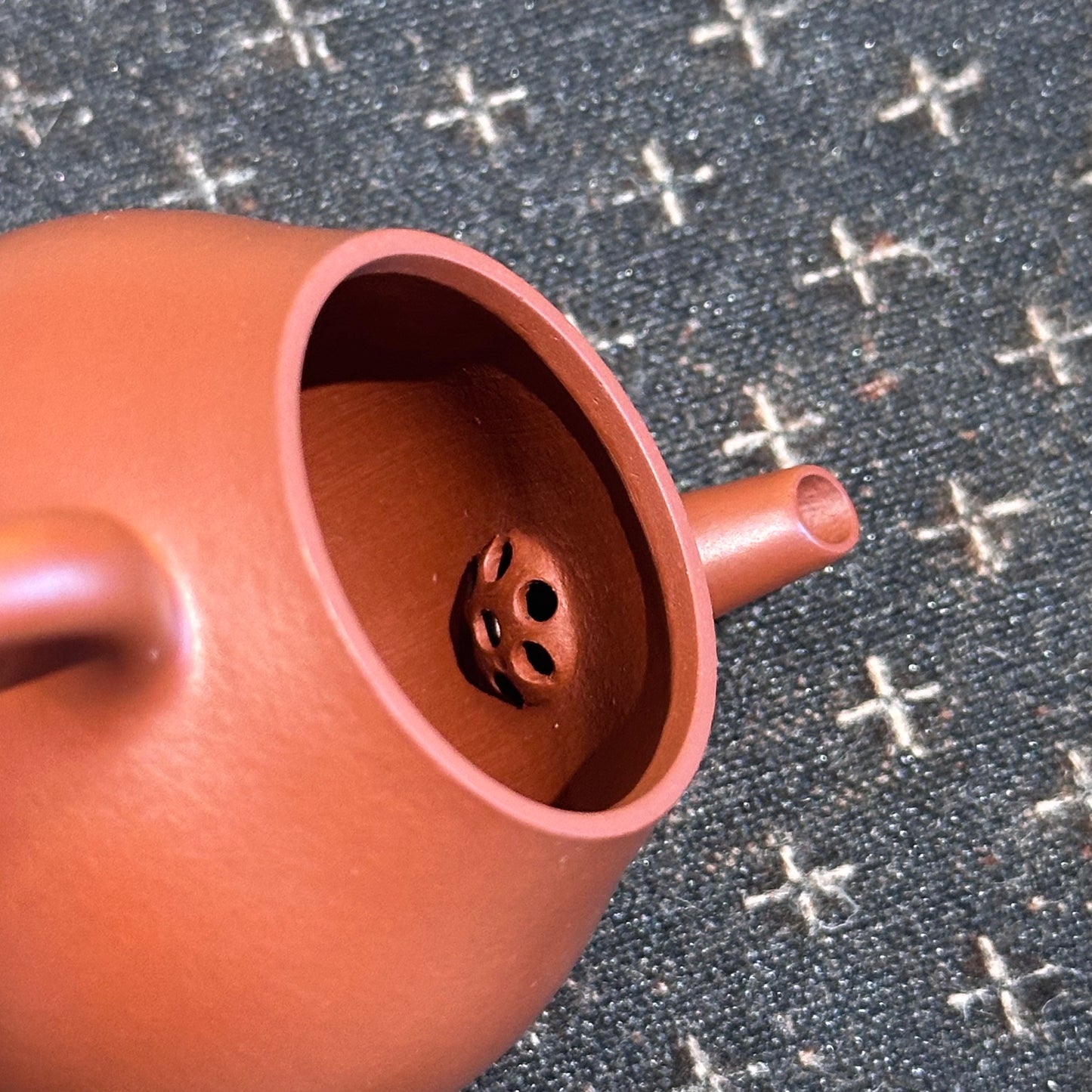
Its versatile character makes it suitable for a wide range of teas. The slender spout provides a smooth pour, while the internal ball-filter design helps keep tea leaves inside the pot.
Aroma-enhancing, without making the tea feel stuffy.
With regular use and care, the surface can gradually develop a warm, smooth, and naturally lustrous patina. After around one month of consistent use, you may begin to notice a more refined sheen.
A Classic Gongfu Tea Tradition
There is a well-known saying among traditional Gongfu tea drinkers:
“Tea must be Wuyi, the teapot must be Mengchen, and the cup must be Ruoshen.”
It reflects the high regard once given to Wuyi rock tea, small Mengchen-style teapots, and Ruoshen cups. The Mengchen teapot became an iconic choice for Gongfu tea, valued for its compact size and elegant pear-shaped body.
Specifications
-
Material: Natural-mined Yixing Zhu Ni clay
-
Craftsmanship: Fine semi-handmade
-
Capacity: Approximately 90ml
-
Shape: Pear-shaped
-
Filter: Internal ball filter
-
Length: Approximately 9.5cm
-
Opening Diameter: Approximately 3.5cm
-
Height: Approximately 7.5cm
Measurements are approximate. Each teapot is individually made, so slight variations may occur.
Understanding Yixing Teapot Craftsmanship
Yixing teapots are made using different techniques. However, the most important factors are the quality of the clay and the care taken during production.
A well-made teapot using good-quality natural clay can serve you just as well whether it is fully handmade or semi-handmade. The difference lies mainly in the making process, craftsmanship, and collectible value.
1. Fully Handmade
The entire teapot is shaped by the potter using traditional hand-building techniques, without relying on shaping molds.
-
Made entirely by hand.
-
Requires considerable skill, time, and experience.
-
Often has greater artistic and collectible value.
2. Fine Semi-Handmade
The potter uses shaping molds to assist with forming the teapot, then carefully refines and finishes it by hand.
-
Combines mold-assisted shaping with detailed hand-finishing.
-
Offers excellent value for money.
-
Can have collectible value when made with good clay and skilled craftsmanship.
3. Standard Semi-Handmade
The teapot is formed with the help of molds, with less detailed hand-finishing than fine semi-handmade pieces.
-
Mold-assisted production.
-
Generally more focused on practical everyday use.
-
Quality still depends on the clay and the maker's workmanship.
4. Machine-Made Teapots
These teapots are produced using mechanical equipment for faster and more efficient manufacturing.
-
Mass-production method.
-
Often prioritizes production efficiency over detailed craftsmanship.
-
Clay quality can vary, and good-quality natural clay should never be assumed.
We generally do not recommend this type when seeking a carefully crafted Yixing teapot.
5. Chemically Altered Clay Teapots
Some teapots are made with clay that has been artificially colored or treated with chemical additives to create unusual appearances.
-
May feature bright, unnatural colors such as vivid green or blue.
-
The color may not reflect the natural appearance of the original mineral clay.
-
Unknown additives and unsafe materials can pose potential health risks.
We strongly advise against using teapots made with unidentified or potentially harmful chemical additives.
What Matters Most?
A teapot's quality should never be judged by its production method alone.
Good natural clay, responsible material preparation, skilled craftsmanship, and proper firing are all important. A fine semi-handmade teapot can be an excellent choice for everyday Gongfu tea brewing, while a fully handmade piece may offer additional artistic and collectible value.