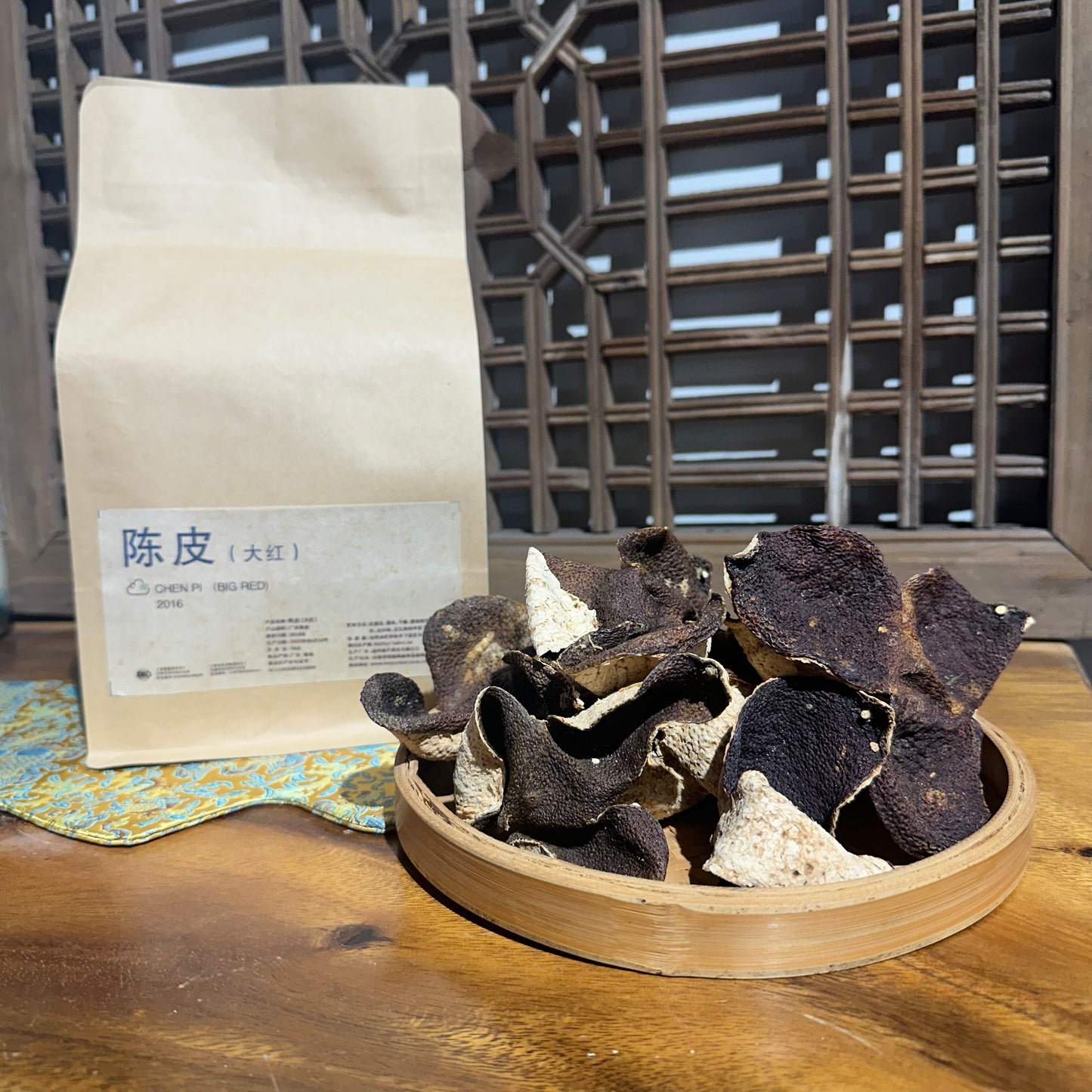

Chenpi · Big Red Peel ·Quan Zhi (Air-Layered Trees)
Vintage: 2011 / 2016
About the Origin of Our Chenpi
Our Chenpi comes from Xinhui, Guangdong,
the most famous and recognized Chenpi producing region in China.
In Xinhui, Cha Zhi Gan trees are mainly grown in three ways:
1. Yuan Zhi (Original Tree)
These are original, naturally grown trees.
They have the most authentic genetics and the purest flavor.
2. Quan Zhi (Air-Layered Trees)
This method is done on an original Cha Zhi Gan tree.
A branch is wrapped with soil while still attached to the tree.
After it grows roots, the branch is cut and replanted.
Quan Zhi trees keep the original genetics of the mother tree
and produce very clean, balanced, and traditional Chenpi flavor.
3. Bo Zhi (Grafted Trees)
These are grafted onto red lemon rootstock.
They grow faster and produce higher yields,
but the flavor is usually less refined.
Our Choice
Our Chenpi is made from Quan Zhi trees.
This means:
Original genetics
More traditional taste
Cleaner aroma
Better aging potential
Bo Zhi trees are common in the market because of higher yield,
but Quan Zhi and Yuan Zhi are widely considered to have better quality.

1. Chenpi vs. Xiao Qing Gan (Small Green Tangerine)
Many tea drinkers confuse Xiao Qing Gan and Chenpi,
but they actually come from the same tree — a citrus tree called Cha Zhi Gan.
The difference is when the fruit is picked.
At different stages of growth, the fruit can be used in different ways:
-
June–July
Very small fruit, locally called “baby gan.” Aroma is very strong. -
July–August
This is Xiao Qing Gan, often filled with ripe Pu’er tea. -
September–October
Called green fruit. The taste is sharp and strong, often used for medicinal purposes. -
October–November
Called Er Hong fruit. This stage is very suitable for aging. -
After December
Called Big Red fruit. Fully mature and commonly used to make Chenpi.
True Chenpi usually refers to peel made from Er Hong fruit or Big Red fruit,
and it must be aged for at least 3 years.
2. What Is Big Red Peel?
Big Red Peel is Chenpi made from fruit harvested after December.
Its main features:
-
Fully mature peel
-
Higher natural sugar content
-
Stable aroma
-
Easy to store and age
Like Pu’er tea, Chenpi improves with time.
But different harvest stages age in different ways.
3. Big Red Peel vs. Er Hong Peel (Simple Explanation)
This is something experienced tea drinkers often care about.
Big Red Peel
-
Sweeter
-
Less acidic
-
Very drinkable even when young
-
Aroma is mainly sweet and mellow
Er Hong Peel
-
Less sweet, slightly sour
-
More aromatic compounds
-
Aroma types are more complex
-
Young Er Hong can be a bit sharp, similar to lemon peel
-
Improves greatly with long aging
-
With time, cooling notes like mint may appear
Because of this:
-
Beginners often prefer Big Red Peel
-
Experienced collectors often like to store Er Hong Peel
There is no better or worse.
It’s simply personal preference.
4. Product Options
2016 Big Red Peel Chenpi (About 10 Years Aged)
Already in a good drinking stage.
-
Clean aroma
-
Clear citrus sweetness
-
No strong sharpness
Good for:
-
Daily drinking
-
Pairing with ripe Pu’er tea
-
Pairing with Moonlight White tea
Easy to drink, not heavy or bitter.

2011 Big Red Peel Chenpi (About 15 Years Aged)
Fully matured.
-
Sweeter and smoother
-
More stable aroma
-
Almost no刺激 or sharpness
-
Clean and warm aftertaste
Good for:
-
Experienced tea drinkers
-
Autumn and winter drinking
-
Long-term daily use
5. How to Drink
Chenpi can be brewed alone,
but pairing is very common:
-
Chenpi + Ripe Pu’er: thicker body, more sweetness
-
Chenpi + Moonlight White: clean, sweet, layered taste
6. One Honest Line
If you want something easy to drink now, choose Big Red Peel.
If you like storing tea and waiting for changes, Er Hong Peel is interesting.
Chenpi is not about comparison.
Time does the work.
What matters most is what you enjoy drinking.
A Few Final Notes & Brewing Tips
We try our best to keep the Chenpi peel as complete as possible.
A full peel comes from one Cha Zhi Gan fruit, naturally divided into three connected sections.

All orders are shipped as complete peels.
However, during transportation, minor breakage may occur, which is normal and does not affect quality.
When you receive the Chenpi, you can gently break the peel by hand.
You will notice a clear and natural citrus aroma.
Before Brewing
Because Chenpi is aged for many years,
a small amount of dust may appear on the surface.
We recommend rinsing it briefly with clean water before use.
How to Boil Chenpi (Recommended)
-
Use one complete 3-piece peel
-
Place it in the pot with peel side down, pulp side up
-
Add 300 ml water
-
Bring to a boil, then boil for 3 minutes
You can add more hot water and boil again.
Chenpi can be boiled multiple times.
For better flavor, you may add:
-
Yunnan ancient tree white tea, or
-
Ancient tree ripe Pu’er tea
Brewing time and water ratio can be adjusted to your taste.
How to Brew (Gaiwan or Teapot)
-
Break the Chenpi into smaller pieces
-
Add boiling water
-
Steep for 2–3 minutes, then pour out
You can also use a thermal flask for longer steeping.
Chenpi is flexible.
There is no fixed rule—
adjust it the way you enjoy drinking it.