

BaiYun teahouse
The Four Famous Bushes of Wuyi Rock Tea Oolong Tea
The Four Famous Bushes of Wuyi Rock Tea Oolong Tea
لم نتمكن من تحميل توفر الاستلام
The Four Famous Bushes of Wuyi Rock Tea
Oolong Tea
武夷岩茶四大名丛 · A Heritage Collection of Four Distinctive Oolongs
Four Legendary Cultivars. Four Distinctive Personalities. One Journey Through Wuyi Rock Tea.
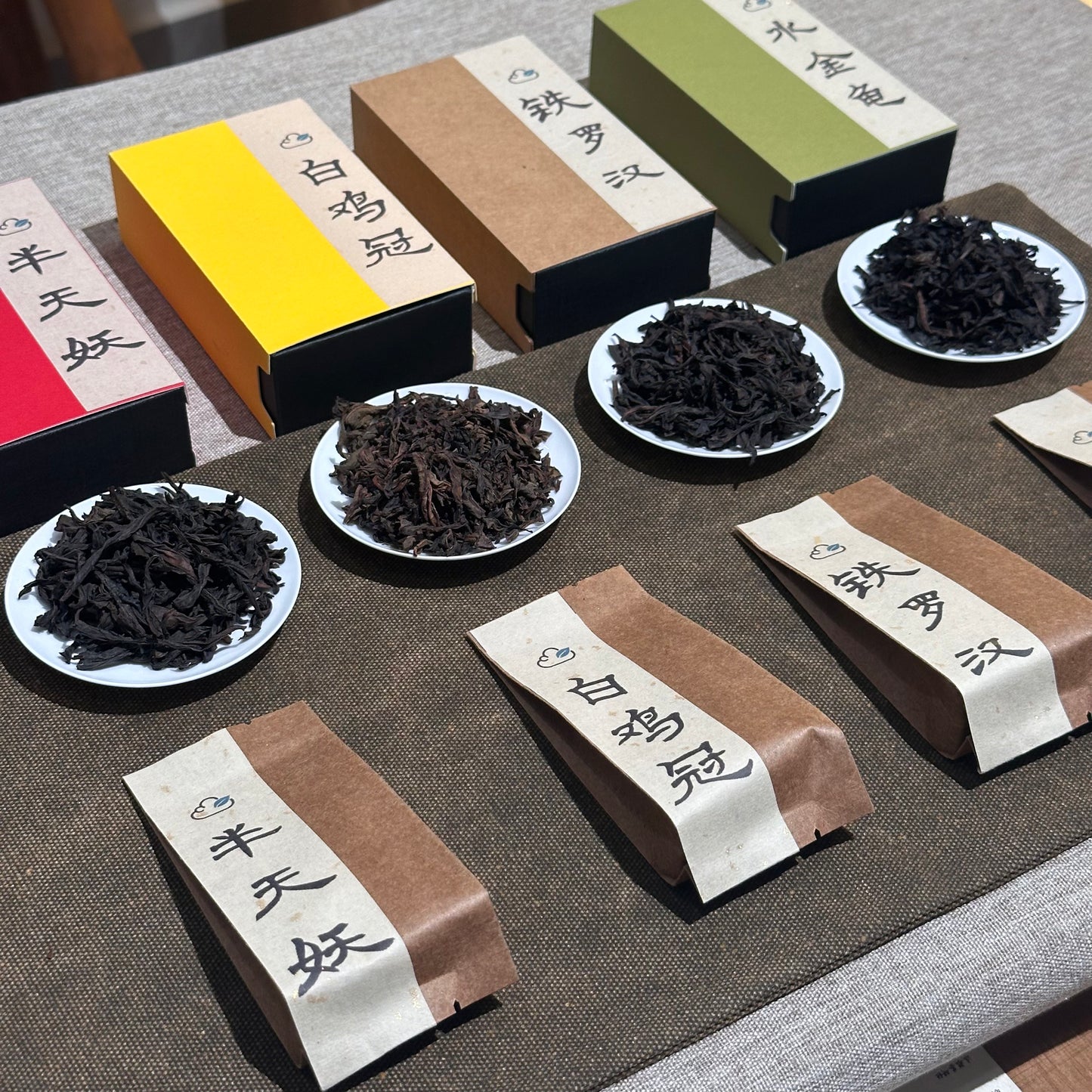
Deep in the rocky mountains of Wuyi, Fujian, grow some of China's most celebrated oolong tea varieties. Among them, four traditional cultivars hold a particularly special place in the history of Wuyi Rock Tea: Shui Jin Gui, Ban Tian Yao, Bai Ji Guan, and Tie Luo Han.
All four teas in this collection come from Zhengyan (正岩), the core rocky growing area of Wuyi Mountain, renowned for its unique growing environment and the distinctive mineral character known as Yan Yun (Rock Essence).
Unlike the three widely recognized commercial names—Rou Gui (Cinnamon), Shui Xian (Narcissus), and Da Hong Pao (Big Red Robe)—the Four Famous Bushes represent a more traditional and historic side of Wuyi Rock Tea.
They are often regarded as the old aristocrats of Wuyi tea: four distinctive cultivars, each with its own history, personality, and characteristic fragrance.
This collection gives you the opportunity to discover all four, side by side.
The Four Famous Bushes · 四大名丛
01. Shui Jin Gui (水金龟)
Water Golden Turtle · The Elegant Floral Aristocrat
Orchid Fragrance · Plum Blossom Aroma · Silky Texture
Roasting Level: Medium Roast

The name Shui Jin Gui, meaning Water Golden Turtle, comes from both the appearance of its fresh leaves and the environment in which the original tea tree grew.
When sunlight falls on its leaves, their appearance is said to resemble the golden shell of a turtle. The original tree was also associated with a moist, rocky environment, giving rise to the name Water Golden Turtle.
Among the Four Famous Bushes, Shui Jin Gui is particularly admired for its refined and graceful fragrance.
Its characteristic aroma is often described as plum blossom, accompanied by delicate orchid-like and floral notes. The fragrance is clean, airy, and quietly persistent. Rather than being overly sweet or flamboyant, it has an elegant penetrating quality that gradually unfolds.

Aroma
The distinctive plum blossom fragrance emerges from the moment you lift the lid of the Gaiwan. It is also beautifully present in the empty cup after drinking, where it lingers with an almost weightless elegance.

Taste
The tea liquor has a concentrated, almost syrupy body, yet its texture is remarkably fine and silky. Delicate floral notes are woven into the liquor itself rather than simply floating above it.
Its sweetness develops gently, leaving a long, graceful finish.
Character: Elegant, refined, floral, silky, and quietly powerful.
For a larger quantity of Shui Jin Gui, click here.

02. Ban Tian Yao (半天妖)
Half-Sky Demon · The Mysterious and Changing One
Floral Fragrance · Peach Sweetness · Evolving Rock Essence
Roasting Level: Medium Roast

Ban Tian Yao has one of the most intriguing names among the Four Famous Bushes.
According to local tradition, the original mother tree grew on a steep, high cliff in Wuyi Mountain, in a place called Ban Tian Yao. The location was so elevated that it seemed almost reachable only by birds.
The name is also associated with the alternative names Ban Tian Yao (半天鹞, Half-Sky Hawk) and Ban Tian Yao (半天腰, Halfway Up the Mountain).
But the word Yao (妖), often translated as demon or enchantress, has another interesting interpretation when describing this tea: its flavor seems to change from one infusion to the next, as if it has a little magic of its own.

Aroma
Gentle, delicate floral fragrance is its signature. As the tea cools, subtle creamy notes may emerge from the infused leaves.
Its fragrance is elegant rather than overpowering, with a beautiful combination of floral and fruity aromas.

Taste
The liquor is soft, smooth, and naturally sweet, with a rounded, rich texture.
One of its most fascinating qualities is how its character changes between infusions. One steep may emphasize floral fragrance and peach-like sweetness, while the next reveals more fruit, depth, and mineral rock character.
The returning sweetness is quick, leaving a pleasant impression long after each sip.
Character: Mysterious, floral, fruity, sweet, and constantly evolving.
For a larger quantity of Ban Tian Yao, click here.

03. Bai Ji Guan (白鸡冠)
White Cockscomb · The Unconventional Aristocrat
Herbal Sweetness · Sweet Corn Aroma · Hidden Floral Fragrance
Roasting Level: Medium-Light Roast

Bai Ji Guan, meaning White Cockscomb, is perhaps the most visually distinctive of the Four Famous Bushes.
Unlike the darker leaves of many other Wuyi Rock Tea cultivars, Bai Ji Guan has relatively thin, pale-colored leaves, with young buds displaying a soft, creamy-white appearance.
The shape and color are said to resemble the white crest on a rooster's head, which is how it received its name.
Its flavor is equally unusual. It offers a very different expression of Wuyi Rock Tea, with a gentle sweetness and distinctive herbal character.

Aroma
The first impression is sweet and warm, with an aroma reminiscent of fresh sweet corn. As the tea develops, delicate floral notes gradually emerge.
Interestingly, some of its most beautiful floral fragrance can be found in the infused leaves. As the leaves cool, the fragrance becomes even more noticeable.

Taste
The liquor is gentle, naturally sweet, and remarkably smooth.
A subtle herbal sweetness reminiscent of traditional Chinese botanical ingredients is accompanied by delicate honey-like and floral notes. The fragrance remains understated, appearing more as a delicate layer within the tea than an overpowering aroma.
Character: Gentle, unusual, sweet, herbal, and quietly floral.
For a larger quantity of Bai Ji Guan, click here.

04. Tie Luo Han (铁罗汉)
Iron Arhat · The Powerful Rock Tea Classic
Woody Fragrance · Herbal Aromatics · Deep Rock Essence
Roasting Level: Medium-Heavy Roast

Tie Luo Han, meaning Iron Arhat, is traditionally regarded as one of the oldest and most powerful cultivars among the Four Famous Bushes.
According to local historical stories, Buddhist monks at a temple in Wuyi Mountain used this tea medicinally during the Qing Dynasty. Its name is traditionally associated with the robust appearance of its leaves, which were likened to the garments worn by an Arhat, a figure representing spiritual attainment in Buddhist tradition.
Tie Luo Han is often considered the most classically rock-like of the Four Famous Bushes. It combines pronounced floral fragrance, substantial body, and a distinctive mineral character.

Aroma
Its fragrance develops in layers.
The opening brings woody notes, accompanied by clear floral aromas and a subtle herbal fragrance. As the tea opens up, deeper herbal and botanical aromas become more prominent.
Here, herbal aromatics does not mean the unpleasant smell or taste of bitter medicine. It refers to the warm, complex fragrance found in traditional Chinese herbal ingredients, such as dried roots, woody botanicals, and aromatic herbs.
These deeper notes are balanced by lighter floral and woody fragrances, creating a complex and harmonious aroma.

Taste
Despite its powerful fragrance and strong character, the liquor is surprisingly smooth, rounded, and thick.
It has a substantial, almost silky texture, with a deep herbal character settling into the background of the tea liquor. Floral notes provide a lighter counterpoint, creating a balance between strength and refinement.
Character: Powerful, deep, woody, herbal, floral, and full-bodied.
For a larger quantity of Tie Luo Han, click here.

Four Teas · Four Different Expressions
| Cultivar | Signature Aroma | Tea Character |
|---|---|---|
| Shui Jin Gui | Plum blossom, orchid | Silky, elegant, refined |
| Ban Tian Yao | Floral, peach, cream | Sweet, changing, layered |
| Bai Ji Guan | Sweet corn, herbal, floral | Gentle, sweet, unusual |
| Tie Luo Han | Woody, herbal, floral | Deep, rich, powerful |
The beauty of this collection lies in the contrast.
One is delicate and elegant, one is mysterious and ever-changing, one is gentle and unconventional, and one is powerful and deeply rooted in the character of Wuyi Rock Tea.
Rather than looking for a single favorite, take the time to discover how differently four cultivars from the same mountain can express themselves.
Gongfu Brewing Guide
To appreciate the character of these four teas, we recommend using a Gaiwan or small teapot.
Tea-to-Water Ratio: 1:13–1:15
For example, use 8g of tea with approximately 104–120ml of water.
Water Temperature: 100°C / 212°F throughout the session.
Preparation
Before brewing, rinse your Gaiwan or teapot with boiling water to warm the vessel. This helps awaken the tea's fragrance.
Infusion Guide
-
Infusions 1–3: Pour immediately after adding boiling water. No additional steeping time is necessary. Enjoy the fresh fragrance and lively Rock Essence.
-
Infusions 4–6: Gradually increase each steeping time by approximately 5 seconds.
-
Infusion 7 onward: Increase each steeping time by approximately 10 seconds as needed, adjusting according to the tea's strength.
Important Brewing Tips
-
Avoid excessively long steeping times, which can make the tea liquor too concentrated.
-
Drain the Gaiwan or teapot completely after every infusion.
-
Do not leave tea liquor sitting in the vessel between infusions, as this may create unwanted bitterness.
The goal is to allow each cultivar to reveal its own fragrance, texture, and evolving flavor.

What's Included
-
Shui Jin Gui (Water Golden Turtle): 2 × 8g packs
-
Ban Tian Yao (Half-Sky Demon): 2 × 8g packs
-
Bai Ji Guan (White Cockscomb): 2 × 8g packs
-
Tie Luo Han (Iron Arhat): 2 × 8g packs
Total: 8 individual packs · 64g of Wuyi Rock Oolong Tea
All four teas are sourced from Zhengyan, the core growing area of Wuyi Mountain, Fujian, China.

Discover the Old Aristocrats of Wuyi
The Four Famous Bushes are more than four names in the history of Chinese tea.
They represent four distinct cultivars, four different aromatic worlds, and four expressions of the unique terroir of Wuyi Mountain.
From the delicate plum blossom fragrance of Shui Jin Gui to the deep herbal and woody character of Tie Luo Han, every tea offers something different to discover.
Four legendary cultivars. One mountain. A whole world of fragrance in eight little packs.
Bishi Yan — A Zhengyan Tea Garden in Wuyi Mountain
One of the Ninety-Nine Famous Rocks of Wuyi Mountain
Bishi Yan (碧石岩) is one of the Ninety-Nine Famous Rocks of Wuyi Mountain and a Zhengyan (正岩) tea-growing area, located in the central part of the Northern Scenic Area of Wuyi Mountain.
Its name, meaning “Green Stone Cliff,” comes from the distinctive landscape of the mountain. The cliffs display beautiful shades of blue and green, while lush trees cover the surrounding slopes, adding to the rich greenery of the scenery. Large rocks are scattered throughout the entire growing area. The tea gardens are surrounded by rocky formations and mountain peaks, and even the soil consists largely of small rock particles. This distinctive rocky landscape is what gave Bishi Yan its name.
Location & Elevation
-
Elevation: Approximately 402 meters
-
Location: Northern foothills of Wuyi Mountain Scenic Area, Fujian, China
-
Geographic position: North of Longfeng Yan, northeast of Lianhua Peak, and northwest of Liuguanzhai
-
Classification: Zhengyan Core Growing Area
Mountain Terrain & Natural Environment
Bishi Yan is a mountain formation extending from north to south, approximately 200 meters in length. Its terrain features a combination of steep rocky cliffs and distinctive rock formations. The southern section has steep cliff faces, while the northern summit forms a conical shape, narrow at the top and broader toward its base. Another distinctive, rounded rock formation can be found along the eastern foothills.
The mountain is enclosed by surrounding peaks on both sides of its valley. This natural landscape helps shield the tea gardens from dust and particles carried in from the outside, while allowing the tea trees to receive soft, diffused sunlight.
Rather than being exposed to strong, direct sunlight throughout the day, the tea gardens benefit from the changing light filtered through the surrounding mountain landscape.
The combination of rugged rock formations, rocky soil, surrounding peaks, and naturally filtered sunlight gives Bishi Yan its distinctive mountain environment.
The Character of a Zhengyan Origin
In Wuyi Rock Tea, the growing environment is an essential part of a tea's identity. Bishi Yan is not simply a place name on a tea label; it is a specific rocky landscape within Wuyi Mountain's Zhengyan area.
All four teas in this collection — Shui Jin Gui, Ban Tian Yao, Bai Ji Guan, and Tie Luo Han — come from Bishi Yan.
Although they share the same growing area, each cultivar has its own distinctive character, aroma, and flavor. Their differences allow tea drinkers to explore the diversity of Wuyi Rock Tea while experiencing the character of the same Zhengyan mountain environment.